Free tool · No chips, no sign-up
Baccarat Predictor Tool
Call the next hand yourself, then test eight prediction methods on freshly shuffled shoes.
Baccarat Predictor: Can Anything Call the Next Hand?
By Baccarat.gg Editors · Last updated November 20, 2026
Your Turn: Predict the Next Hand
Call Player or Banker on the table, or tap either hand. One hand is dealt from a shuffled eight-deck shoe and your call is scored.
Your calls
0 right of 0
No calls scored yet
Ties
0 ties, which are not scored
About 1 hand in 10.5 ties
Cards left
416 cards left in the shoe
A new shoe starts below 52
Player
Banker
After ten scored calls, this line compares your record with a coin toss.
What eight prediction methods say about the next hand
This table shows what eight prediction methods call for the same hand and how each has done so far.
| Method | Its call for the next hand | Right so far |
|---|---|---|
| Always Banker | Banker | no calls yet |
| Always Player | Player | no calls yet |
| Follow the last winner | Banker | no calls yet |
| Bet against the last winner | Banker | no calls yet |
| Back the hot side | Banker | no calls yet |
| Back the side that is due | Banker | no calls yet |
| Pattern matcher | Banker | no calls yet |
| Coin toss | Tossed at the deal | no calls yet |
The methods often disagree with one another, and whichever is in front after twenty hands is often not in front after two hundred. How each one makes its call is listed under the tester below.
Results this shoe
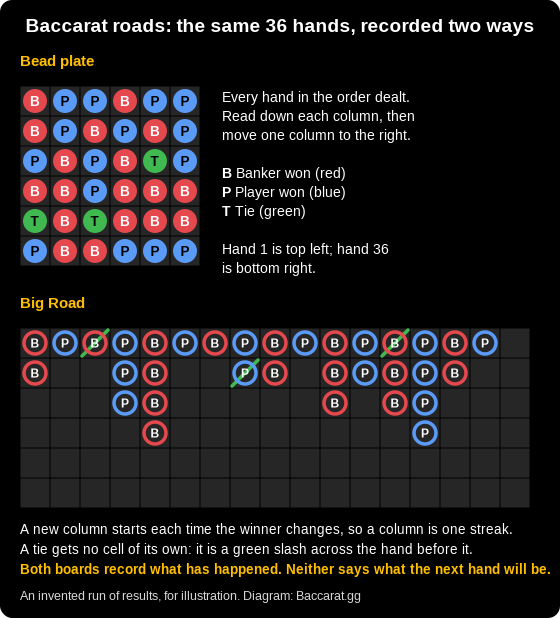
The Bead Plate and the Big Road, as a casino screen draws them. This is everything a predictor has to work with.
Big Road Banker and Player wins. A new column starts each time the winner changes; a green line is a tie.
Bead Plate Every hand in order, top to bottom.
People look for a baccarat predictor online hoping to find software, an app or an AI that calls the winner of the next hand. None can. This page lets you prove that for yourself instead of taking our word for it. It is free, it runs online in your browser with nothing to download and no sign-up, and it uses no chips at all: the only thing scored is whether a call was right.
The tool above is the first of two. It lets you call the next hand yourself, with eight prediction methods making their calls beside you. The second, below, runs those eight methods over as many as 100,000 hands and compares each one with a coin toss.
No software, app, AI or pattern can predict the next hand of baccarat.
The cards are shuffled, and the hands already dealt say almost nothing about the ones to come. The most dependable call is Banker, on every hand. That call is right on 50.68% of the hands that do not tie, and it still loses, because a winning Banker bet pays 0.95 to 1. Whatever a predictor says, each bet keeps its house edge:
| Bet | House edge | What a predictor changes |
|---|---|---|
| Banker | 1.06% | Nothing |
| Player | 1.24% | Nothing |
| Tie | 14.36% | Nothing |
Worked out exactly on our Odds & Payouts page.
Prediction Method Tester: Eight Methods Against a Coin Toss
Each method sees what a player or an app at the table could see: which side won each earlier hand of the shoe. It makes its call before the hand is dealt, and all eight are scored on the same hands. Pick a number of hands and run the test.
Hands
Choose a number of hands, then press Test the methods.
How each method makes its call
- Always Banker. Call Banker on every hand.
- Always Player. Call Player on every hand.
- Follow the last winner. Call whichever side won the last hand.
- Bet against the last winner. Call the side that lost the last hand.
- Back the hot side. Call the side that has won more of the last ten hands.
- Back the side that is due. Call the side that has won fewer of the last ten hands.
- Pattern matcher. Take the last three results, find every earlier place in this shoe where the same three came up in a row, and call whichever side followed most often.
- Coin toss. Call a side at random.
Each method knows only the hands of the current shoe and starts every new shoe with a blank history. When it has nothing to go on, or its count is level, it calls Banker. "The last ten hands" means the last ten that did not tie.
What Our Own Test Found
We ran the eight methods over 16 million hands, dealt shoe after shoe by the same engine as our Baccarat Simulator. 1,523,257 hands tied and 14,476,743 were scored.
Eight prediction methods over 16 million hands (our test, October 11, 2026)
| Method | Hands called right | Result per unit bet |
|---|---|---|
| Always Banker | 50.68% | -1.06% |
| Always Player | 49.32% | -1.23% |
| Follow the last winner | 50.01% | -1.16% |
| Bet against the last winner | 50.01% | -1.13% |
| Back the hot side | 50.19% | -1.12% |
| Back the side that is due | 50.14% | -1.13% |
| Pattern matcher | 50.23% | -1.11% |
| Coin toss | 49.98% | -1.19% |
Share of the hands that did not tie. One standard error of a hit rate over this many hands is 0.013 points. "Result per unit bet" is the result of betting one unit on every call, with ties returned, as a share of everything bet. The exact cost is 1.06% on Banker and 1.24% on Player.
Always Banker called 50.68% of hands right and Always Player 49.32%. The exact figures are 50.68% and 49.32%. The other six methods all landed between 49.98% and 50.23%. The ones a little above 50% are the ones that call Banker more often than Player, because they call Banker whenever their count is level. None called more hands right than Always Banker, and every one of the eight lost money betting its own calls.
Why No Baccarat Predictor Can Work
The shoe is shuffled
Every hand is dealt from the cards that remain in the shoe, in an order nobody knows. A predictor that reads a scoreboard is reading the past. The Bead Plate and the roads are records, and a record of shuffled cards has no rhythm to continue. Our Winning Strategies page covers pattern tracking in more detail.
What real players do with the scoreboard
Real players do read the scoreboard as a guide. A 2025 study in the journal Acta Psychologica analyzed 17,970,830 baccarat games played by 6,625 customers of a casino in South Korea between April 2017 and August 2019. After a single Player win, customers bet on Player 46.6% of the time. With each further Player win in the streak, the odds that they bet Player rose by about 38%, and the figures for Banker streaks were almost the same. More than nine customers in ten showed the pattern. When they bet with a streak, their bets also grew by 2% to 3% with each step of it. Once a streak was broken, the pattern disappeared.
The study's authors are plain about what a streak means. The order of the cards is fixed by the shuffle, any trend in the results is a coincidence, and there is no rational basis for betting on one. They also note that following a trend on Player or Banker does not change what the bet is expected to return. Our test shows the same thing from the other side: following the last winner was right on 50.01% of the hands that did not tie, the same as betting against it. The authors suggest the scoreboard itself may feed the habit, because it stacks repeated results in a column and draws the eye to a streak. That explanation is theirs and has not been tested.
The one real pattern is too small to use
Banker wins 50.68% of the hands that do not tie and Player wins 49.32%. That lean toward Banker comes from the drawing rules and it is the only dependable regularity in the game. It is also already priced in. A Player bet pays 1 to 1, so Player calls must be right 50% of the time to break even, and they are right 49.32%. A Banker bet pays 0.95 to 1, so Banker calls must be right 51.28% of the time, and they are right 50.68%. A predictor would have to close a gap of 0.60 points on Banker or 0.68 points on Player just to reach zero. Those gaps are what the house edge is made of: 1.06% of every Banker bet and 1.24% of every Player bet, worked out exactly on our Odds & Payouts page.
Even knowing every card that has gone barely helps
A card counter knows more than any scoreboard shows: the rank of every card that has left the shoe. Michael Shackleford's analysis of baccarat card counting at Wizard of Odds works out a strategy that bets Player when the count favors it and Banker the rest of the time. With it the combined house edge is 1.01%, against 1.06% on Banker and 1.24% on Player without counting. The player still loses. That page is clear that studying which side won earlier hands does not help, and that counting cards helps only a little. A predictor that sees only who won each hand has far less to go on than a card counter does.
The Three Kinds of Baccarat Predictor App
The baccarat predictor apps and online tools on offer mostly fall into three groups. None of them changes the cards or the payouts, and each can be checked against the tests on this page.
Scoreboard trackers
You tap in each result, or the app reads it from the table, and it draws the roads: the Bead Plate, the Big Road and the three roads derived from it, Big Eye Boy, Small Road and Cockroach Pig. That is a record of hands already dealt, the same thing the screen at a live table shows. It is useful for keeping track and useless for calling the next hand. In our test of 16 million hands, five methods that read earlier results the way road readers do each called between 50.01% and 50.23% of hands right, against 49.98% for a coin toss.
Betting-system apps
Some apps pair their calls with a staking plan, most often Martingale, which doubles the bet after every loss so that one win recovers the run. The plan changes the size of the bets, not the chance of winning them, so the house edge on every chip stays where it was, and a long losing run meets the table limit or the end of the bankroll. The betting system tester on our simulator page runs Martingale and five other systems on the same hands as flat betting, so you can watch it happen with pretend chips.
AI and pattern-recognition apps
These say a model has learned to spot patterns or streaks in past results. A model can only learn what is in its data, and the results of a shuffled shoe hold one regularity: Banker wins 50.68% of the hands that do not tie. Any app that leans on that will be right a little more than half the time and still lose to the commission. To check a claim, count every call made before the cards are dealt, over thousands of hands, as the method tester above does.
What About Predicting the Next Card?
Some people want the next card instead of the next winner. A fresh eight-deck shoe holds 416 cards, 32 of each rank, so any one rank comes next 1 time in 13 (7.69%). Tens, jacks, queens and kings all count as zero, so a zero-valued card comes next 4 times in 13 (30.77%). Those chances shift a little as cards are dealt, and anyone can work out the shift by counting what has gone. Nobody can say which card is next, because the order of a shuffled shoe is not known until each card is turned over.
How a Predictor Can Look Like It Works
- Short runs. A coin toss gets 60 or more of 100 calls right about 2.8% of the time, roughly one run in 35. Try enough methods for enough short runs and an impressive streak turns up sooner or later. Run the tester above at 100 hands a few times to see it happen.
- Only the good runs are shown. A screenshot records a run that worked. The runs that did not are rarely posted.
- Calling Banker a lot. Any method that mostly says Banker will be right slightly more than half the time, and will still lose to the commission.
- A staking plan behind the calls. Some tools pair their calls with a plan that raises the bet after a loss. That produces many small winning sessions and a few very large losing ones, whatever the calls are. The betting system tester on our simulator page shows how.
When we searched Google for "baccarat predictor" on October 11, 2026, the first page of results included a video that claimed 95% accuracy. Test any such claim the way this page does: count every call, made before the cards are dealt, over thousands of hands. Over 1,000 calls a coin toss lands between about 47% and 53% nineteen times in twenty. A method that was right even 55% of the time would win more than 6% of every chip it bet, and nothing in baccarat's arithmetic leaves room for that.
Using a Predictor in a Casino
In Nevada it is a crime to use, or to possess with the intent to use, a device, software or hardware designed to obtain an advantage at a game in a licensed casino. The law names devices that project the outcome of the game, keep track of the cards played, or analyze probabilities or betting strategy (NRS 465.075). A first offense is a category C felony (NRS 465.088). Other states and countries have their own laws. This is general information, not legal advice.
What to Use Instead
- To know the real odds at your table, use the Baccarat Probability Calculator. It gives the exact chance and cost of every bet for your deck count and payouts.
- To practice without money, use the Baccarat Simulator. It deals from the same shoe as this page, with pretend chips.
- To keep the cost down, the arithmetic is short: Banker costs 1.06% of each bet, Player 1.24%, and the Tie bet far more. No call changes those figures.
If you came here hoping a predictor could win back money you have lost, no tool can do that. Our Responsible Gaming page lists confidential helplines that are open around the clock.
Frequently Asked Questions
Is there a baccarat predictor that really works?
No. Nothing can predict the winner of the next baccarat hand well enough to beat the game. The most reliable call is Banker every time, which is right on 50.68% of the hands that do not tie, and it still loses 1.06% of every chip wagered because a winning Banker bet pays 0.95 to 1. The tester on this page runs eight prediction methods on shuffled shoes so you can check this yourself.
Can AI predict baccarat?
No. An AI can only learn from results that have already happened, and in baccarat those results come from shuffled cards. The order of a shuffled shoe holds no pattern for a model to learn. The most it can find is what is already known: Banker wins slightly more often than Player, 50.68% against 49.32% of the hands that do not tie.
What is the most accurate way to predict the next baccarat hand?
Call Banker every time. With eight decks Banker wins 50.68% of the hands that do not tie and Player wins 49.32%. In our test of 16 million hands, Always Banker was right 50.68% of the time, and no other method was right more often. It still lost 1.06% of every unit bet, because of the 5% commission on Banker wins.
Do baccarat roads and scoreboards predict the next hand?
No. The Bead Plate, the Big Road and the roads derived from it record what has already happened. In our test of 16 million hands, five methods built on earlier results (following the last winner, betting against it, backing the hot side, backing the side that is due, and matching patterns) each called between 50.01% and 50.23% of hands right. A coin toss called 49.98%. Players follow the boards anyway: a 2025 study of 17,970,830 games at one casino found that more than nine customers in ten tended to bet with a streak.
Can card counting predict baccarat?
Only very slightly, and not enough to win. A card counter knows which cards have left the shoe, which is more than any scoreboard shows. Wizard of Odds analyzed a counting strategy that bets Player when the count favors it and Banker the rest of the time: it brings the combined house edge to 1.01%, against 1.06% on Banker and 1.24% on Player without counting. The player still loses.
Is this baccarat predictor tool free?
Yes. It is free and runs in your web browser. There is nothing to download, no account to create, and no chips or money are involved. It scores calls and nothing else.
Is it legal to use a baccarat predictor app in a casino?
In Nevada it is a crime to use, or to possess with the intent to use, a device, software or hardware designed to obtain an advantage at a game in a licensed casino, including one that projects the outcome of the game or keeps track of the cards played (NRS 465.075). A first offense is a category C felony (NRS 465.088). Other states and countries have their own laws. This is general information, not legal advice.
Sources: the exact probabilities are from our Probability Calculator, for eight decks and a 5% commission. The card counting figures are from Wizard of Odds (Michael Shackleford, last updated August 3, 2026), read October 11, 2026. The study of bettors is Muto, Nakai, Murai, Yoshikawa and Abe, "Baccarat gamblers follow trends rather than adhere to the gambler's fallacy: Analyses of field data from a casino," Acta Psychologica 258 (2025); read in full October 11, 2026. The casino's affiliated company supplied the data and funded the study. Nevada Revised Statutes 465.075 and 465.088, read October 11, 2026. The hit rates are from our own test, run October 11, 2026. Baccarat.gg is an affiliate site; this page carries no casino promotion and is not affiliated with any prediction product.